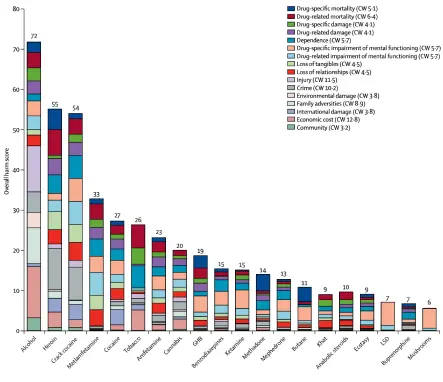
In general, if taken in a clean and secure environment with proper emotional support, psilocybin is a safe substance. In a 2010 study by British Professor David Nutt, which measured harmful drugs in the UK, mushrooms proved to be the safest of the twenty substances studied, as shown in the figure below.
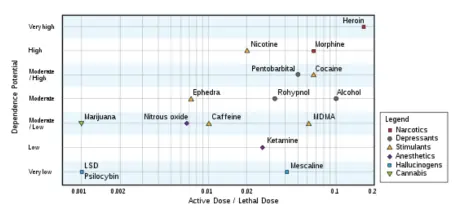
While studying the toxicity of various substances, Professor Robert Gable found that psilocybin (along with other psychedelics such as LSD and mescaline) has little to no potential for creating substance dependence. Gable also found that magic mushrooms are physiologically safe — they cannot physically harm you, even at extremely high doses.
Because psilocybin is such a powerful substance, you’ll want to understand how it can interact with certain conditions and medications. If you may be impacted by potential contraindications, it’s best to consult with supportive and knowledgeable mental health or medical professionals. Toward the end of the next section, you’ll find a list of potential resources.
In any case, if you want to try psilocybin, you’ll want to “start low and go slow.” You can always take more, but cannot take less. Having solid community support will help your mental health journey, regardless of your circumstances.
If you have a history of schizophrenia or psychotic disorders, experimenting with psilocybin is not recommended. If you have a known family history of schizophrenia and are under the age of 30, you’ll want to be extra careful.
Some journeyers have reported success using psilocybin to treat certain personality disorders (e.g., borderline, narcissistic, schizoid, anti-social), but excellent care and support is necessary in these cases. Please proceed with caution if you have been diagnosed with a personality disorder.
Those with Bipolar Disorder I or II diagnoses (collectively, BD) have traditionally been excluded from clinical research with psilocybin. However, some people with these diagnoses have reported tremendous success with psychedelics. A growing segment of researchers and mental health professionals believe BPD II is a nervous system dysregulation resulting from trauma, in which case psilocybin may be an ideal medicine. However, please proceed with caution if you have been diagnosed with BD and are considering psychedelics. Please refer to the next section on medications if you are taking any for this condition.
Psilocybin can temporarily increase heart rate and blood pressure, so you’ll want to take precautions if you have heart issues such as uncontrolled hypertension, cardiovascular disease, or aneurysms.
If you have an addiction-related condition such as active alcohol withdrawal, please seek medical support and avoid psilocybin for the moment.
If you have a history of neurological disorders (e.g., stroke, epilepsy, traumatic brain injury), you’ll want to proceed with caution and experiment with smaller doses to start.
If you are pregnant or breastfeeding, you’ll want to do your research and consult with those who have expertise in this domain.
If you have anger management problems, or active suicidal or homicidal ideation, psilocybin is not recommended. If you’ve had previous suicide attempts that required hospitalization, you must understand that psilocybin can amplify certain thoughts, and may not be the best fit.
If you have an unstable life situation (e.g., housing, relationships), you may find it helpful to first stabilize yourself. For some, microdosing has helped them take steps to accomplish their goals.
Ultimately, the choice is yours. Whatever you decide, please remember that you are responsible for your choices. In the next section, you’ll learn about how psilocybin interacts with certain pharmaceutical medications.